Chronic Neck Pain? Could It Be the Way You Breathe?
Chronic neck pain that will not quit? A shallow, chest-dominant breathing pattern keeps your scalenes, sternocleidomastoid, and upper traps working overtime. Here is how to spot it — and how we treat it.
If you've had neck pain that just won't quit — the kind that's been around for months — you've probably worked through the usual lineup: stretching, massage, a new pillow, posture reminders. When those only buy a day or two of relief, it's natural to assume the problem is your neck itself.
There's an often-overlooked contributor hiding in plain sight, though: the way you breathe.
We see this pattern constantly in our Carmel and Delphi clinics: someone with chronic neck tightness who also breathes shallowly with their upper chest. Their scalenes, sternocleidomastoid, and upper trapezius are essentially working overtime on a job that was never theirs. When we address both the neck and the breathing pattern, results tend to stick.
Your diaphragm is supposed to do the work
You take somewhere around 20,000 breaths per day. Every one is a chance for the right muscles to do their job — or for the wrong ones to get recruited.
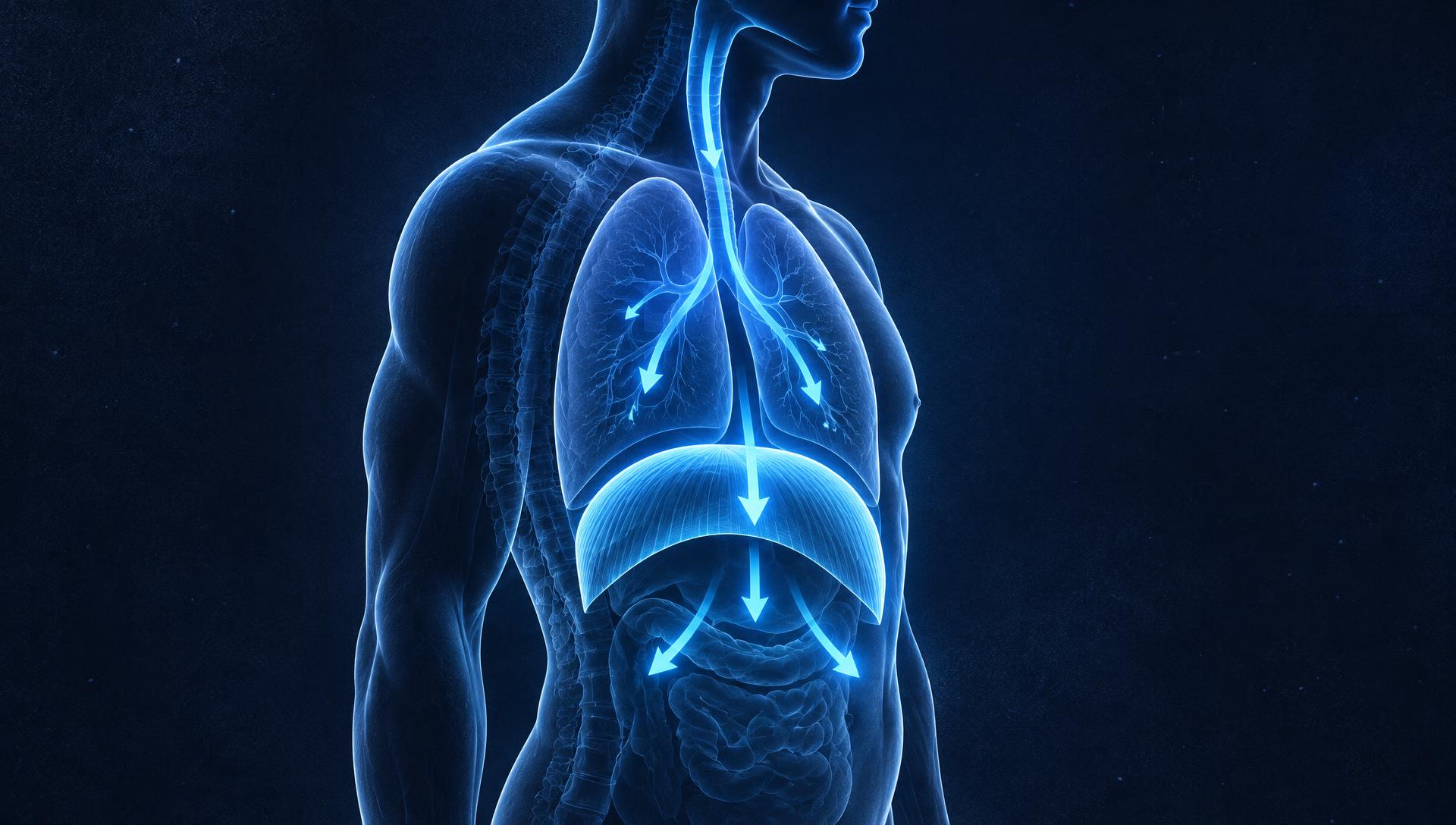
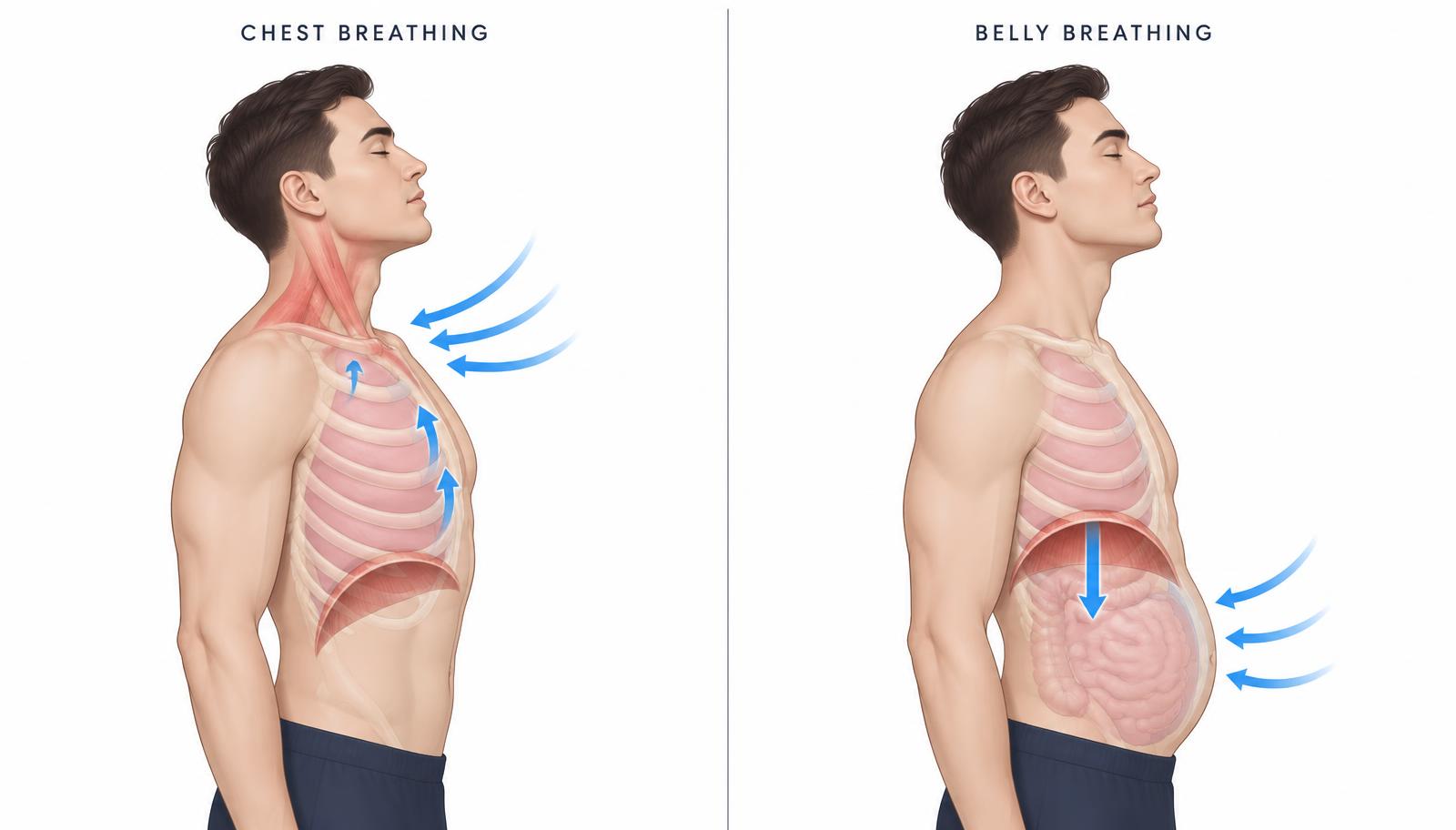
In a healthy pattern, your diaphragm — the dome-shaped muscle separating your chest from your abdomen — handles most of the work. As it contracts and descends, your belly and lower ribs expand, your chest stays relatively quiet, and your shoulders don't move.
What chest breathing does to your neck
When the diaphragm doesn't lead, your body borrows. The substitutes are the accessory breathing muscles: the scalenes and sternocleidomastoid in your neck, and the upper trapezius and levator scapulae along the top of your shoulders.
Those muscles were built for emergencies — sprinting, an asthma attack, a hard set of stairs — where they help lift the upper ribs for a few big, urgent breaths. Chest breathing asks them to run the whole show, all day, every day.
Over time that can look like:
- Tight, tender scalenes and upper traps — the classic "knots at the top of my shoulders"
- Stiff neck and headaches that show up by late afternoon
- Jaw and neck tightness when you wake up — shallow chest breathing is common during poor sleep and stress
- Forward head posture that reinforces the whole pattern
- Rapid, shallow breathing that keeps your nervous system in "alert" mode, raising resting muscle tone and pain sensitivity
Research supports the connection. A pilot study found that people with chronic neck pain had significantly reduced maximal voluntary ventilation and respiratory muscle strength — and that weaker respiratory strength was strongly associated with more forward head posture Kapreli et al., 2009. A related paper laid out the proposed mechanism: weak deep neck flexors, overactive superficial neck muscles, restricted motion, and disturbed neuromuscular control can all push breathing toward the accessory muscles Kapreli et al., 2008.
Which comes first?
Usually both, in a loop.
A sore, guarded neck makes people breathe shallowly and high in the chest. Shallow chest breathing keeps the accessory muscles constantly engaged, which keeps the neck irritated. Around it goes.
That's why breaking the loop from both directions works better than treating either side alone. In a randomized controlled trial, breathing re-education improved deep neck flexor endurance and strength in patients with chronic neck pain Anwar et al., 2022. Another RCT found that a therapeutic program with respiratory exercises improved posture, muscle activity, and breathing pattern in people with neck pain and forward head posture Dareh-deh et al., 2022. And a recently published randomized controlled trial found that cervical spine and diaphragm manual therapy combined with breathing re-education produced larger improvements in pain and neck disability than conventional physiotherapy alone Journal of Clinical Medicine, 2026.
A 60-second self-test
Sit upright and relax. Place one hand flat on your upper chest and the other on your belly. Breathe normally for about a minute and notice:
- Chest hand moves a lot, belly hand stays still → likely a chest-dominant pattern
- Shoulders lift toward your ears on the inhale → accessory muscles are helping more than they should
- Frequent sighing or yawning, waking with a tight jaw or neck, or feeling like you can't get a full breath at your desk → common companions of the same pattern
One note: everyone's pattern varies day to day. This is a screening tool, not a diagnosis.
A drill to start with: 360° belly breathing
- Lie on your back with your knees bent (or feet up on a couch).
- Put one hand on your belly and one on your chest.
- Inhale slowly through your nose for about 4–5 seconds. Let your belly — and lower ribs — rise while your chest stays quiet.
- Exhale slowly and relaxed for 6–8 seconds, slightly longer than your inhale.
- Practice for about 5 minutes, once or twice a day.
Once it feels automatic lying down, take it to sitting, standing, and finally while working at a desk. Two cautions: don't force your belly outward, and don't take huge gulping breaths — slower and gentler beats deeper and harder.
How we treat this at Indy Spine and Rehab
Breathing drills alone rarely fix a problem that took months or years to develop. Here's what a plan looks like at our Carmel and Delphi clinics:
- A full assessment — how your neck moves, which muscles are guarding or overactive, and how you breathe at rest and under stress
- Manual therapy — hands-on work to restore motion in the cervical and thoracic spine and release the overworked accessory muscles
- Dry needling — for stubborn trigger points in the scalenes, sternocleidomastoid, upper traps, or levator scapulae
- Breathing re-training — diaphragmatic control progressed from quiet breathing to breathing under load, so the pattern holds up in real life
- Strength and endurance work — deep neck flexors, shoulder blade stabilizers, and the postural endurance desk work demands
- A plan to make it stick — so the new pattern becomes automatic instead of something you think about for a week
When to get checked sooner
See a provider promptly if you have numbness, tingling, or weakness into an arm; a headache with neck stiffness or fever; pain after a fall or accident; or pain that keeps worsening despite care.
The takeaway
Breathing didn't necessarily cause your neck pain — but chronic neck pain and chronic chest breathing travel together, and treating only one of the two is a common reason relief doesn't last. If that sounds familiar, it's worth having both checked.
Book an evaluation at Indy Spine and Rehab — contact us — and let's find out what your breathing is doing to your neck.
References
- Kapreli E, Vourazanis E, Strimpakos N. Neck pain causes respiratory dysfunction. Medical Hypotheses. 2008;70(5):1009–1013. PubMed
- Kapreli E, et al. Respiratory Dysfunction in Chronic Neck Pain Patients. A Pilot Study. Cephalalgia. 2009;29(7). DOI
- Anwar S, et al. Effects of breathing re-education on endurance, strength of deep neck flexors and pulmonary function in patients with chronic neck pain: A randomised controlled trial. South African Journal of Physiotherapy. 2022;78(1). Full text
- Dareh-deh HR, Hadadnezhad M, Letafatkar A, Peolsson A. Therapeutic routine with respiratory exercises improves posture, muscle activity, and respiratory pattern of patients with neck pain: a randomized controlled trial. Scientific Reports. 2022. Full text
- The Effectiveness of Cervical Spine and Diaphragm Manual Therapy Combined with Breathing Re-Education Exercises on Musculoskeletal, Respiratory and Psychophysiological Outcomes in Patients with Non-Specific Chronic Neck Pain: A Randomized Controlled Trial. Journal of Clinical Medicine. 2026. DOI