
How Do I Know If I Can Train Through the Pain?
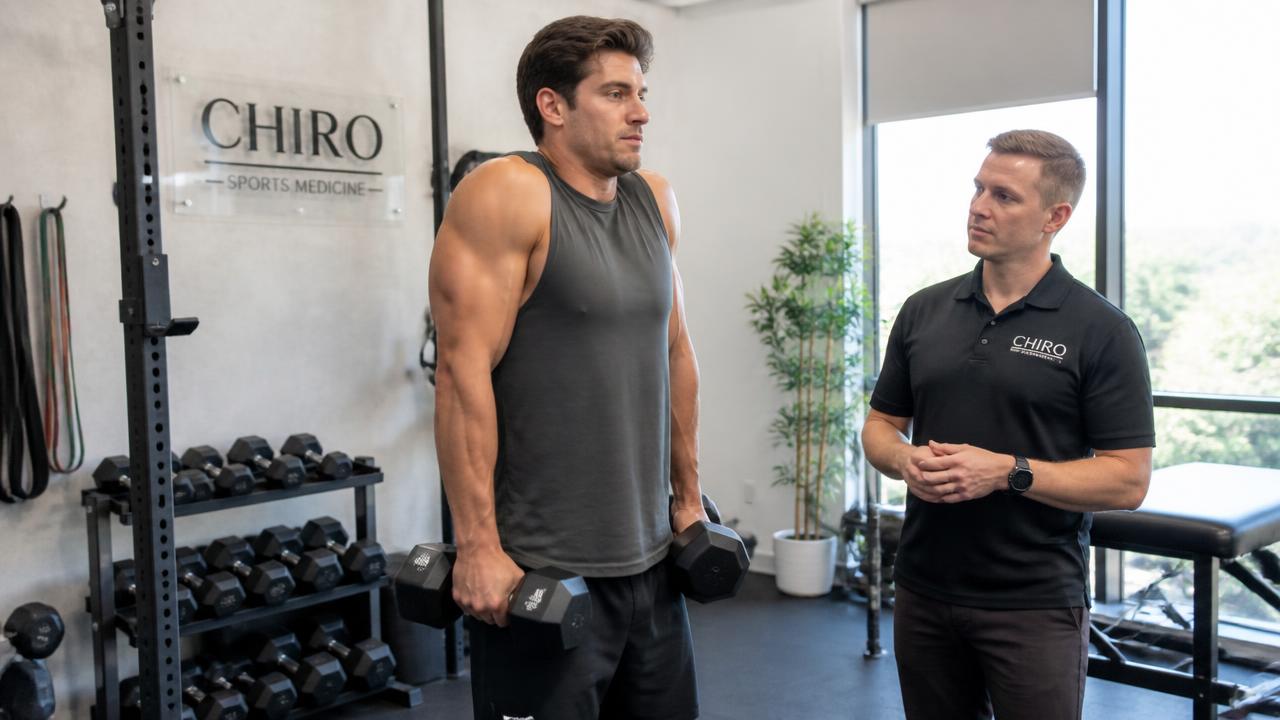
Optimal loading, explained: if your range of motion is full and stable and pain stays at or below 3/10, it is usually safe to train. Here are the rules we use — and the trap-pain case that proved it.
Almost every athlete and active adult we see in Carmel asks some version of the same question: "Can I keep training, or am I making this worse?" The honest answer is that rest is rarely the whole answer — and complete rest is often the reason people plateau.
The framework we use is called optimal loading.
What is optimal loading?
Optimal loading means giving an injured or irritated tissue enough mechanical stress to stimulate healing and adaptation, without exceeding what it can tolerate that day. It replaced the old "rest, ice, protect it" mindset for a reason: tendon, muscle, disc, and joint tissue all remodel in response to load. Take the load away entirely and the tissue gets weaker, less tolerant, and more sensitive.
This is the same logic behind the PEACE & LOVE framework that replaced RICE in sports medicine, and behind the well-documented success of progressive loading for tendinopathy — heavy slow resistance and eccentric programs consistently outperform rest for Achilles and patellar tendon pain. Loading is the treatment, not the risk.
The two rules we use in the clinic
Rule 1: Full, stable range of motion = safe to train
If you can move the joint through its full active range of motion, with control, and without the joint giving way, shifting, or sharply catching — that motion is available to you and it is safe to load. Stability and control matter more than the presence of a little soreness.
If range is clearly limited, unstable, or you get a hard mechanical block, that's the signal to stop and get assessed before you load it.
Rule 2: Keep pain at or below 3/10
This is the pain-monitoring model, and it's well supported in the research on tendon and shoulder rehab. During the set, keep pain at 3/10 or less. If pain climbs above a 3, stop the set, reduce the load, shorten the range, or slow the tempo.
Two more checkpoints:
- Pain should settle back to your baseline within 24 hours.
- Symptoms should not be steadily worse week over week.
Soreness at a 2 or 3 that fades by the next morning is not damage. It is the tissue being asked to adapt.
Red flags — do not train through these
- Pain above 3/10 that does not settle with less load
- Swelling, locking, or the joint buckling
- Sharp, electric, or radiating pain down an arm or leg
- Numbness, tingling, or true weakness
- Pain after a fall, collision, or crash
- Night pain that wakes you up
Those need an exam, not a heavier dumbbell.
A real case: the trap pain that hit a ceiling
We treated a patient with persistent upper trapezius and neck pain. We started with the usual approach — soft-tissue work, adjustments, dry needling, mobility. It worked. He went from a rough 7/10 down to about a 3/10 and felt noticeably better.
Then he stalled. Weeks went by at that same 3/10. Better, but never gone. He was avoiding anything that "lit it up," which meant he had quietly stopped loading his shoulders and upper back entirely.
So we changed the plan. Instead of protecting the area, we started training directly into it using the rules above: full range, controlled, pain kept at or under 3/10. Shrugs, carries, prone and banded scapular work, then progressive overload week to week. Some sessions felt like a 2 or 3. Every time, it settled by the next day, so we kept adding load.
Within a few weeks the ceiling broke. The pain that hadn't moved in over a month resolved completely — and he ended up stronger than before the injury. The tissue didn't need more protection. It needed capacity.
How to apply this to your next workout
- Test the range first. Move the joint through its full motion. Full and controlled? Green light.
- Pick a load you can keep at 3/10 or less for the whole set.
- Regress the variable, not the exercise. Reduce weight, shorten range, slow the tempo, or drop the reps before you drop the movement.
- Re-check in 24 hours. Back to baseline? Add a little next session.
- Progress weekly, not daily. Small jumps in load beat big ones.
When to get looked at
If you've plateaued the way our patient did, if pain keeps breaking the 3/10 ceiling, or if you're unsure whether the range is truly stable, that's exactly what an evaluation is for. We'll test the joint, find the actual limiter, and build a loading plan you can train on — instead of guessing.
We treat athletes and active adults at our Carmel and Delphi locations. If pain is capping your training, book an evaluation and let's get you loading again.