Massage vs. Active Release Technique (ART): What's the Difference?
Massage and Active Release Technique both work on soft tissue — but they do it differently. Here's how they compare, where they overlap, and why ART may help when massage hasn't.
If you've had a massage that felt great for a day — only to have the same tight, achy spot come right back — you're not alone. Massage and Active Release Technique (ART) both treat muscles and connective tissue, but they're built for different jobs. Here's what each one does, and how to know which one fits your problem.
What is massage?
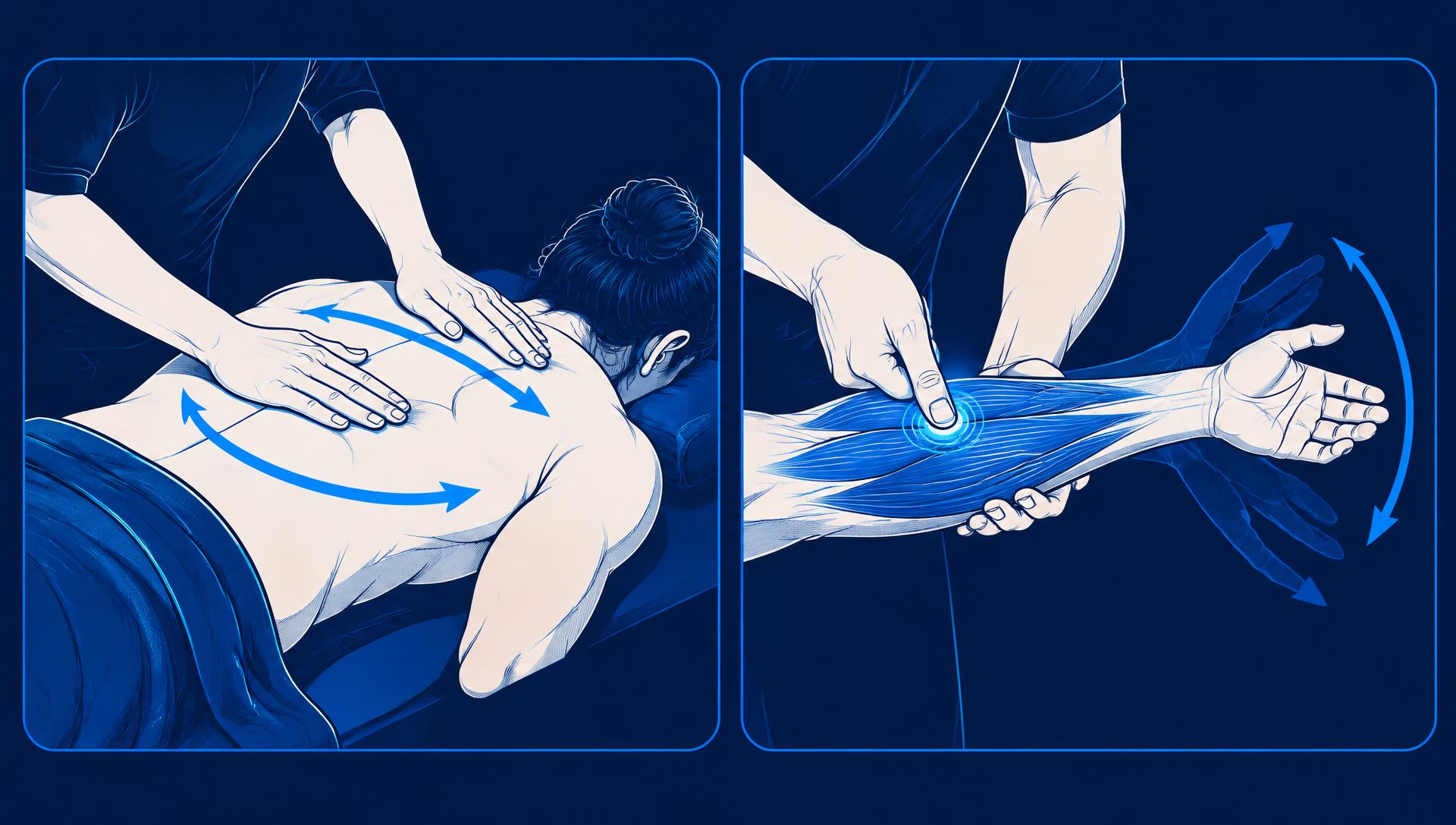
Massage uses broad strokes, kneading, and pressure to work over large areas of muscle. Here's how it works:
- Relaxes tight muscles and calms the nervous system. Slow, steady pressure signals your nervous system that it's safe to let go, easing protective muscle guarding and general soreness.
- Boosts blood flow. Working over large areas increases circulation, which helps ease soreness and supports recovery after hard training.
- Feels good — and that matters. Massage lowers stress and perceived tension, which is a big part of why the relief you feel is real.
Massage is passive — you lie still, and the therapist does the work. That makes it excellent for general relaxation, recovery, and diffuse tightness.
What is Active Release Technique?
ART is a hands-on, movement-based soft tissue method. The provider locates a specific area of tension or adhesion in a muscle, tendon, ligament, or nerve pathway, applies precise contact tension, and then you actively move the area through a specific range of motion. The tissue lengthens under the contact — like sliding the tissue out from under a pinned point.
Here's how it works:
- Improves flexibility by targeting the same muscle repeatedly with precise pressure while you move through your range of motion, training the tissue to lengthen and glide the way it should.
- Reduces pain and sensitivity by working directly on the exact restricted spot, calming irritation in the tissue itself instead of just relaxing the area around it.
- Frees up nerves by releasing tight tissue where a nerve passes through, so the nerve can glide and move without getting pinched or irritated.
How they're similar
- Both are manual therapies targeting muscle and fascia.
- Both can reduce pain and perceived tightness and improve how tissue moves.
- Both work partly through the nervous system — reducing protective muscle guarding and pain sensitivity — not just by "breaking up" tissue.
- Neither is a cure on its own; both work best paired with movement and strengthening.
How they're different
| Massage | Active Release Technique | |
|---|---|---|
| Focus | Broad areas of muscle | Specific structures and restrictions |
| Your role | Passive — you relax | Active — you move during treatment |
| Assessment | General feel for tension | Diagnosis of the exact tissue involved |
| Best for | Relaxation, recovery, general tightness | Localized injuries, scar tissue, repetitive strain, nerve tension |
| Session feel | Soothing | Intense but brief, targeted |
Why ART may help when massage hasn't
If massage keeps giving you temporary relief, the reason is often that the real problem is specific:
- The restriction is localized. Repetitive strain (typing, running, throwing, lifting) can create focal areas where tissue layers don't glide well. Broad pressure may relax the muscle around it without addressing the exact spot.
- The tissue needs to move under load. ART combines pressure with active movement, retraining how the tissue lengthens and slides — something a passive massage doesn't do.
- A nerve may be involved. Numbness, tingling, or pain that radiates can come from a nerve that's irritated where it passes through tight tissue. ART providers are trained to trace and treat these pathways.
- It's tied to a diagnosis. ART starts with assessing which structure is the problem, so treatment is aimed at the cause rather than the symptom area.
That's why we never use ART in isolation — we combine it with a full evaluation and an active rehab plan.
How we use ART at Indy Spine and Rehab
At our Carmel and Delphi clinics, every visit starts with an evaluation to figure out why the tissue is tight. From there, your plan may include:
- Active Release Technique to target the specific restricted tissue
- Chiropractic adjustments to restore joint motion
- Dry needling or Graston when appropriate
- Corrective exercise and strengthening so the problem doesn't keep coming back
Massage has a great place in recovery and wellness. But if you've tried it and the same pain keeps returning, it may be time for a more targeted approach.
Ready to find out what's really going on? Book an evaluation with our team.